When you form a bar chord, you will hold down all six strings (sometimes five) with a finger (usually the first finger, but not always). You will, in effect, use your finger as a "bar." These chords have a great advantage, for they can be moved anywhere on the neck to form just about any chord desired. The disadvantage is they are very hard to play. To play them well, and to be able to switch from one chord to another within a progression, is even harder. If you can't yet play bar chords, here are some exercises to help.
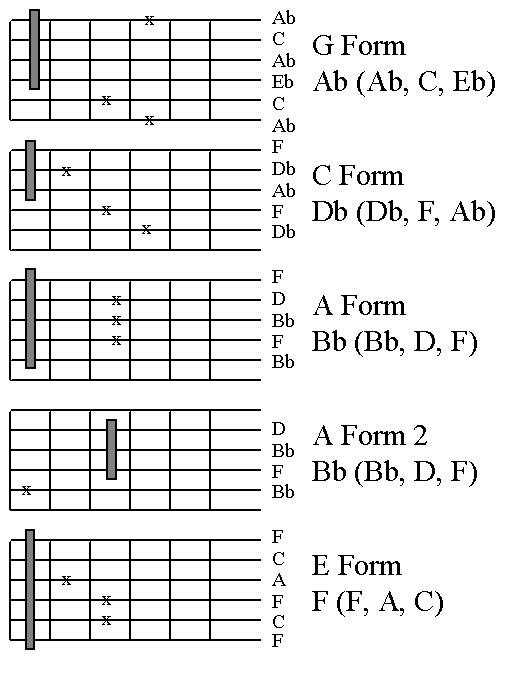
Figure 1 shows five bar chord forms for major chords: G, C, A (two forms), and E. These forms get their names from the chords used to derive them. For the E form, create an E chord, then move it one fret towards the guitar body to get an F (major) chord. Move it one more to get a Gb, and one more to get a G, and so on.
Since I cannot come close to playing the G form, I'll ignore it from this point forward. The first A form is also quite difficult (at least, I can't play it) – you need to cram your second, third, and fourth fingers onto the the third fret of strings four, three, and two – all while holding down five strings with your first finger. To do the second A form, you have to hold down three strings with your fourth finger, without touching the first string – I can't play this either. The E form is easier (although it can still take months or more to learn to do it) – I can play it, with difficulty. To get Gb, then G, then Ab, etc., just move the form, one fret at a time, toward the guitar body. If you examine the E form, and don't use the fifth or sixth strings (so you hold down only strings one and two with the first finger), you see that that is the usual form most players first learn when they learn F. And it's usually very difficult to learn even that form. It certainly was for me – it took me months to master the four-string form of F.
The C form is a bit easier than the E form (at least for me, with my very long fingers). Most players first learn Db and Eb as shown, but without the fifth string. (The Eb form is derived by moving the Db form two frets toward the guitar body.) The form shown in Figure 1 is more desirable, since the first note of the chord (Db) is the bass note. Most players learn Bb as shown, in the first A form, but without the fifth string (so they need hold down only the first string with the first finger). Either A form shown in the Figure is better, again since the first note of the chord (Bb) is the bass note.
Figure 1. Bar Chord Forms For Major Chords.
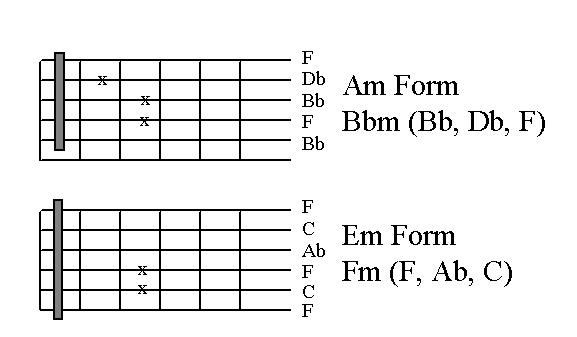
For minor chords, there are two bar chord forms: Am and Em. See Figure 2. The Am form is similar to the A form for major chords. But it's a lot easier (at least for me). Most players first learn Bbm as shown, but without the fifth string (so they need hold down only the first string with the first finger). Then you can get Bm and Cm, and so on – just by moving the form one fret at a time toward the guitar body.
Most players first usually learn Fm as shown, but without the fifth and sixth strings (so it's similar to the beginner's form for F major). In that case, you need only hold down strings one, two, and three with the first finger, then hold down the fourth string with the third finger. For beginners, this (easier) form is usually still quite difficult. Either way, you get Gbm, Gm, and Abm, and so on – by moving the form one fret at a time toward the guitar body.
Figure 2. Bar Chord Forms For Minor Chords.
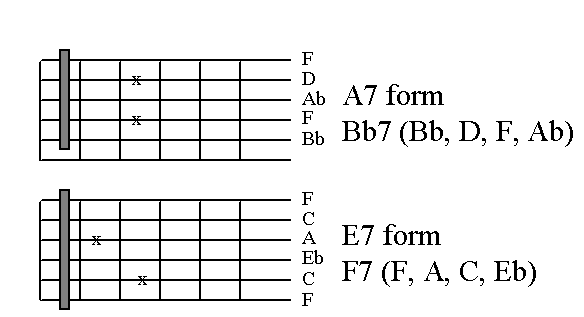
For (dominant) 7th chords, there are two bar chord forms: A7 and E7. See Figure 3. Most players first learn F7 as shown, but with an open fifth string, the first finger holding down the first four strings, and the third finger holding down the third string, second fret. That form is usually still quite difficult. The more difficult form shown has the advantage that the first note of the chord is the bass note. With either the E7 form shown, or the easier one, you then get Gb7, G7, Gb7, A7, and so on moving the form one fret at a time.
The A7 form shown is different from the usual A7 that beginners learn, but it has the advantage that, as it is moved along the neck, the first note of the chord is always the bass note.
Figure 3. Bar Chord Forms For (Dominant) Seventh Chords.